Let’s start with a confession: I have a folder on my phone labeled “Emergency Groaners.” It contains exactly forty-two puns. I have never needed all forty-two at once, but the folder exists because I believe—firmly, perhaps irrationally—that a well-timed pun is the closest thing we have to a verbal Swiss Army knife. It cuts tension. It opens conversations. It occasionally makes people sigh so loudly they fog up their glasses.
Welcome to the strange, wonderful, and occasionally infuriating world of puns jokes. If you clicked this article expecting a dry linguistic analysis, I admire your optimism. If you clicked because you secretly love a good (or gloriously bad) pun and want permission to enjoy them without shame, you are in exactly the right place. Consider this your safe harbor. The snacks are pretzels, because they’re twisted, and I regret nothing.
The Anatomy of a Groan: Why Puns Jokes Hit Different
There is a specific sound a room makes after a pun lands. It is not quite laughter. It is a half-chuckle, half-exhale, often accompanied by a head shake and the phrase “I hate that I liked that.” This reaction is not a failure of the joke. It is the joke working exactly as designed.
Researchers who study humor have a term for this: benign violation . The idea is that we find things funny when they feel wrong or unexpected but ultimately safe. A pun violates the expected meaning of a word—it twists language in a way that shouldn’t work—but it does so harmlessly. No one gets hurt. The grammar police might twitch, but they recover. The pun creates a tiny moment of confusion, followed by a click of recognition. That click is the payoff. It is the mental equivalent of a key turning in a lock you didn’t know was there.
What makes puns jokes particularly fascinating is that they operate on multiple levels simultaneously. On the surface, they are simple wordplay. Beneath that, they are a test of shared knowledge. To “get” a pun, you need to know both meanings of the word being played with, and you need to recognize the absurdity of swapping them. This is why puns often feel smarter than they look. They are tiny puzzles disguised as throwaway lines.
And here is the part that might surprise you: research suggests people actually enjoy puns more than most other joke types . The groan is not a rejection. It is a performance. It is the audience’s way of saying, “I see what you did there, and I am both impressed and mildly annoyed.” That is a remarkable emotional range for nine words about a fish wearing a bowtie.
The Universal Language of “Sofishticated”
One of the great democratic qualities of puns jokes is that they do not require a passport. A pun that works in English might need translation, but the structure of the joke—the setup, the twist, the reveal—is universally recognizable. You can tell a pun to a stranger in a coffee shop, a coworker in a meeting, or a child in the back seat of a car, and the mechanism is the same. It is language play at its most accessible.
Consider the humble “What do you call a fish wearing a bowtie? Sofishticated” . It is not sophisticated humor in the traditional sense. It is, in fact, the opposite. But that is precisely why it works. It asks nothing of the listener except a basic familiarity with the word “sophisticated” and a willingness to accept “fish” as a prefix. The barrier to entry is almost zero. The reward is a small, clean laugh.
This accessibility is why puns thrive in family settings. They are the rare form of humor that can be shared across generations without awkwardness. A grandfather can tell a pun to a six-year-old, and while the six-year-old might not fully grasp the wordplay, they will understand that something funny just happened, and they will laugh because the grandfather is laughing. The pun becomes a social connector, a tiny ritual of shared amusement. The same joke can travel from the dinner table to the school playground to the office break room, and while the audience changes, the fundamental pleasure does not.
There is also something deeply satisfying about the efficiency of a good pun. It does not need a long setup or a complicated backstory. “What do you call a sleeping dinosaur? A dino-snore” . That is eleven words. It contains a complete narrative arc: introduction of subject, identification of characteristic, twist, resolution. It is a haiku of silliness.
The Dad Joke Diaspora: How Puns Conquered the Internet
If you spend any time online—and statistics suggest you do—you have encountered the dad joke. The dad joke is a specific subspecies of puns jokes, characterized by its deliberate corniness, its clean content, and its apparent obliviousness to its own lack of coolness. The dad joke does not care whether you think it is funny. It exists to be told, and your reaction—whether laughter or groan—is merely confirmation that the transaction has occurred.
What is remarkable is how the dad joke has escaped its original habitat. It was once the province of actual fathers, delivered at barbecues and in minivans. Now it belongs to everyone. Teenagers tell dad jokes ironically. College students tell them sincerely. Social media accounts dedicated entirely to terrible puns have hundreds of thousands of followers. The dad joke has become a shared cultural vocabulary, a way of signaling that you are in on the joke—even if the joke is that there is no joke, just a pun about a scarecrow being “outstanding in his field” .
This proliferation is not an accident. Puns jokes are perfectly suited to the internet’s attention economy. They are short. They are shareable. They require no context. A tweet that reads “I’m friends with 25 letters of the alphabet. I just don’t know Y” works just as well as a text message, a caption, or a bumper sticker. The pun is format-agnostic. It travels light.
But there is something else happening here, something slightly deeper than mere shareability. In a digital landscape increasingly dominated by irony, sarcasm, and elaborate layers of meta-commentary, the pun is refreshingly direct. It is not trying to be clever at your expense. It is not mocking you for not understanding. It is simply offering you a small, self-contained moment of wordplay and hoping you enjoy it. The worst-case scenario is a groan. The best-case scenario is a laugh. Either way, no one leaves feeling worse than they arrived. That is a rare quality in modern humor.
A Punctuation Guide to Puns Jokes (See What I Did There?)
Let us take a brief tour through the major categories of puns and jokes, because while they all operate on the same principle, they arrive at their destinations via different routes. Think of this as a field guide for the pun-curious.
The Animal Kingdom Puns. Animals are the workhorses of the pun world, largely because their names and characteristics lend themselves to wordplay with almost suspicious generosity. A bear without teeth is a gummy bear . A dog magician is a labracadabrador . A fish with no eyes is a fshhh . The animal pun is a staple because it combines two things people universally enjoy: animals and wordplay. Even people who claim to hate puns will usually concede that “ground beef” as a description for a cow with no legs is at least structurally sound.
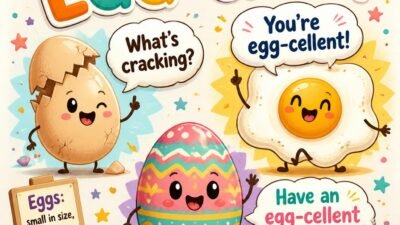
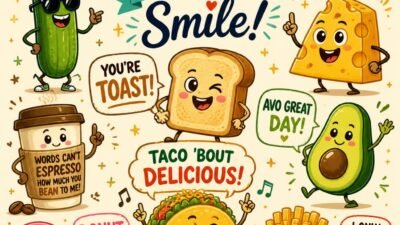
The Food Puns. Food puns operate on a principle of culinary substitution. The joke replaces a word related to food with a similar-sounding word that creates absurdity. “What did the lettuce say to the celery? Quit stalking me” . “Why did the cookie go to the hospital? Because it felt crumby” . The food pun is particularly effective because food is a shared experience. Everyone eats. Everyone has opinions about eating. The pun taps into that universal familiarity and uses it as a launchpad for silliness.
The Occupational Puns. These puns rely on the vocabulary of a particular profession or role. “Why did the math book look so sad? Because it had too many problems” . “What do you call a police officer who won’t get out of bed? An undercover cop” . The occupational pun rewards specific knowledge. If you have ever struggled through algebra, the math book joke lands differently than it would for someone who has not. The pun becomes a tiny moment of recognition, a shared nod between people who understand the reference.
The Existential Puns. These are the puns that flirt with the absurd. “What do you call a fish with no eyes? Fshhh” is not just a joke about a fish. It is a joke about language itself, about the way words can be stretched and broken and still somehow communicate. The existential pun does not care about logic. It cares about the sound of the words and the shape of the laugh they produce.
The Art of the Groan: A Defense of Deliberately Bad Humor
There is a school of thought that says a joke should be clever. It should surprise you. It should reveal something true about the world or the human condition. This school of thought has produced a great deal of excellent comedy, and I respect it enormously.
But there is another school of thought, and it is the school where puns jokes live. This school says that a joke does not need to be clever. It does not need to reveal anything. It only needs to exist, and you only need to be there to hear it. The pun is not trying to change your life. It is trying to make you smile for approximately two seconds. That is a modest goal, but it is an honest one.
The deliberately bad pun—the one that earns a groan rather than a laugh—occupies a special place in this ecosystem. The groan is not a sign of failure. It is a sign of participation. When you groan at a pun, you are acknowledging that the joke worked on you, even if the work it did was to make you roll your eyes. You are saying, “I saw that coming, and I let it happen anyway.” There is something almost affectionate about that. The groan is the audience’s way of playing along.
This is why dad jokes have such enduring appeal. They are not trying to be cool. They are not trying to be edgy. They are trying to be exactly what they are: a pun, delivered with confidence, offered without apology . The dad joke does not need your approval. It only needs your attention. And if you give it that attention, it will reward you with a moment of lightness, a brief pause in the seriousness of the day.
Puns Jokes in the Wild: A Practical Guide to Deployment
Knowing about puns jokes is one thing. Using them effectively is another. Allow me to offer some field-tested advice, drawn from years of personal experience and at least a dozen instances of mild social awkwardness.
Timing is everything. A pun delivered at the wrong moment is not a pun. It is a disruption. The best puns arrive when the room is ready for a shift in tone. After a long meeting. During a lull in conversation. In the middle of a road trip when everyone has run out of things to say. The pun is a change of pace. It works best when the current pace has become unbearable.
Confidence matters more than quality. A mediocre pun delivered with conviction will land more often than a brilliant pun delivered apologetically. The pun is a performance. If you believe in it, the audience will believe in it too. If you hedge—“This is probably dumb, but…”—you have already lost. Commit to the bit. The groan will be warmer.
Know your audience. Not everyone loves puns. Some people, and I say this with genuine sorrow, find them irritating. If you are in a room full of people who have expressed a strong preference for other forms of humor, perhaps save the “dino-snore” for another occasion. The pun is a gift. It should not be forced upon the unwilling.
Do not explain the pun. This is the cardinal rule. If you have to explain why a pun is funny, it is no longer a pun. It is a lecture. The pun should land and then be allowed to sit there, in all its glory, while the audience processes what just happened. Explaining it is like describing a magic trick while performing it. It ruins the effect.
The Science of Silly: What Puns Do to Your Brain
There is actual neuroscience behind this, which is either reassuring or deeply ironic, depending on your feelings about scientists studying humor. When you hear a pun, your brain processes the literal meaning of the words first. Then, when the punchline arrives, it has to reconcile the unexpected twist with the expectation it had already formed. This reconciliation—the “click” of getting the joke—activates the brain’s reward system. The pun literally feels good .
This is why puns can be such effective stress relief. They demand a shift in perspective. They force the brain to abandon one interpretation and embrace another. That cognitive flexibility is the same skill we use when we need to reframe a problem, find a silver lining, or cope with a situation that is not going the way we planned. A pun is a tiny rehearsal for resilience. It teaches us that words can mean more than one thing, that surprises can be pleasant, and that a moment of confusion can resolve into a moment of delight.
There is also a social component to the pleasure of puns. Laughing at a pun is a way of signaling that you are paying attention, that you are engaged, that you are willing to play along. It is a low-stakes form of connection. You do not have to reveal anything personal. You do not have to commit to a deep conversation. You just have to be present enough to catch the wordplay and generous enough to acknowledge it. In a world where so much of our communication is mediated and curated, that kind of spontaneous, in-the-moment connection is valuable.
The Evergreen Appeal: Why Puns Never Go Out of Style
Trends come and go. Slang evolves. The humor of one generation becomes the cringe of the next. But the pun endures. It has been with us for centuries, and it will be with us for centuries more. Why? Because it is built on something fundamental: the structure of language itself. As long as words have multiple meanings, as long as sounds can be twisted and swapped, the pun will have material to work with.
This is what makes puns jokes such a reliable source of entertainment. They do not depend on current events. They do not require cultural context. They do not expire. A joke about a scarecrow being outstanding in his field worked a hundred years ago, and it will work a hundred years from now . The specific words might change, but the mechanism—the unexpected substitution, the moment of recognition—is timeless.
There is comfort in that. In a world that feels increasingly fragmented and fast-moving, the pun is a constant. It is a reminder that some forms of humor are universal, that some pleasures are simple, and that a well-timed “dino-snore” can still make a room full of people smile. The pun does not ask for much. It only asks for a moment of your attention and a willingness to groan.
A Closing Argument for the Groan
So here we are. We have journeyed through the anatomy of the pun, the psychology of the groan, the taxonomy of wordplay, and the practicalities of deployment. We have considered the dad joke, the animal pun, the food pun, and the existential “fshhh.” We have acknowledged that some people do not like puns and agreed to respect their choices, even if we do not understand them.
What have we learned? Perhaps this: puns jokes are not a guilty pleasure. They are a legitimate form of humor, one that deserves to be celebrated rather than apologized for. They are accessible, portable, and endlessly renewable. They connect people across generations and cultures. They make us think, even as they make us groan. They are, in their own small way, a form of optimism. They assume that the world is full of hidden connections, that words are full of surprises, and that a moment of shared silliness is always worth the effort.
So the next time someone tells you a pun the next time someone asks you what you call a bear with no teeth, or a fish with no eyes, or a sleeping dinosaur—do not suppress the groan. Let it out. Let it be loud. Let it be theatrical. The groan is not a rejection. It is an invitation. It is your way of saying, “I am here. I am listening. I am willing to be silly with you.” And that, my friends, is a wonderful thing to be willing to do.

George Smith is a humor enthusiast and writer at PunsStock, where he shares clever puns, funny jokes, witty one-liners, and lighthearted observations. With a passion for wordplay and everyday humor, George enjoys finding the funny side of ordinary moments and turning them into something worth sharing.
When he’s not writing, you’ll probably find him collecting terrible dad jokes, discovering clever wordplay, or trying to make someone laugh.
George Smith — Making words a little funnier, one pun at a time.