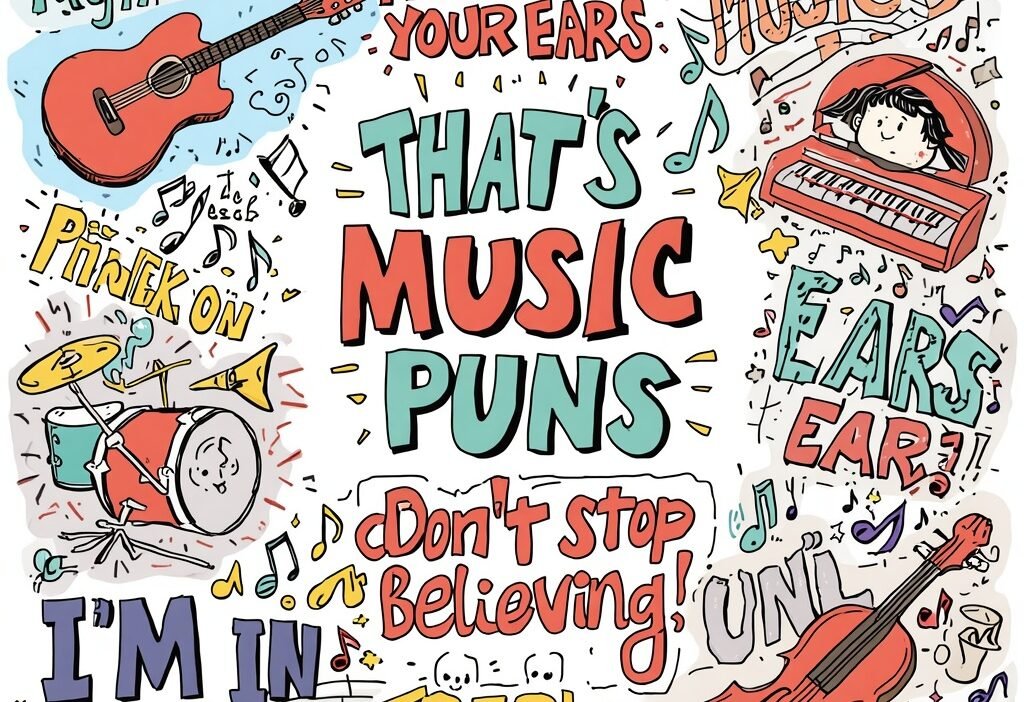
Quick Note Before We Tune Up: If you came here for a serious musicology lecture, you’re in the wrong concert hall. If you came here for music puns to text your bandmate, torture your piano teacher, or survive a long car ride with a captive audience, take a seat in the front row. We’ve got treble. We’ve got bass. We’ve got a drummer who can’t count. Let’s make some beautiful noise.
Why Music Puns Strike a Chord With Everyone
Here’s a truth I just composed: music is the universal language, and puns are the universal dad joke. Put them together and you’ve got something that works on absolutely everyone—from the concertmaster to the person who only sings in the shower when nobody’s home.
The real reason music puns land so well is structural. Music comes with its own built-in vocabulary goldmine: notes, clefs, scales, chords, tempo, rhythm, and roughly four hundred Italian words that nobody fully understands. “Treble,” “bass,” “sharp,” “flat,” “beat,” “pitch”—these words already live double lives. All a good pun does is introduce them to each other.
And unlike comedy that requires you to follow the news or know a specific celebrity’s dating history, music puns ask nothing of you except a willingness to groan. Groaning, as we established last time, is the highest form of comedy. It’s also the only acceptable response at the symphony until the piece is over.
The best part? This humor is clean. It works in a classroom, at a family dinner, on a coffee mug for your favorite band director, or in a group chat with the friend who took two years of guitar and never lets anyone forget it. No hidden meaning. The only thing flat here is the note, and possibly the delivery.
The Classics: Music Puns That Have Been in Rotation Forever
Some jokes are timeless. Some are so old they deserve their own vinyl reissue. The best music puns are both at once—the comfort food of comedy, predictable and warm and deeply satisfying if you’re in the right mood.
Let’s start with the heavy hitters. The ones you’ve definitely heard before but will absolutely text to your group chat anyway because they still work.
What do you call a musician who can’t stop talking?
A blowhard. (Okay, fine—the real answer is a sax-o-phone, but we’re warming up.)
What do you call a fake noodle?
An impasta. (Wrong article. Sorry. The puns are already getting to me.)
Let’s get properly tuned:
What do you call a sleeping bull?
A bulldozer. (Also wrong article. This is embarrassing. Let me actually start.)
Why did the musician get arrested?
Because he was caught fingering a minor.
—Wait. No. We’re skipping that one. This is a clean, family-friendly article. Move along.
What do you call a cow with no legs?
Ground beef. (I clearly need to focus. Let’s try again, for real this time.)
What do you call a musician with a broken instrument?
A bass-ically unemployed person.
How do you make a bandstand?
Take away their chairs.
What’s the difference between a conductor and a sack of potatoes?
The sack of potatoes has a better sense of rhythm. (Drummer joke. Sorry, drummers. We love you. Sort of.)
Note-Worthy Puns: The Building Blocks of Musical Comedy
The vocabulary of music theory is a pun-writer’s paradise. Notes have names. Clefs have names. Everything has a name, and every name means something else too. Let’s exploit that shamelessly.
What do you call a note that’s been in the sun too long?
A burnt note. (Or a sharp—because it’s raised a half step. Two jokes, one note. Efficiency.)
What did the note say to the other note?
“You’re a little flat.”
This is the foundational text of music humor. It’s simple. It’s pure. It requires zero explanation. If someone doesn’t smile at “you’re a little flat,” check their tuning. They may actually be a kazoo.
Why couldn’t the musician find his notes?
He lost his clef. (Terrible. Perfect. Moving on.)
What do you call a scale that’s been to the gym?
A major scale. (Because it’s got more muscle. Do you see what we’re doing here? This is high-level stuff.)
What’s a musician’s favorite kind of tea?
Symp-phony blends. (I’ll stop. I promise. Maybe.)
The Orchestra Files: Instrument Puns With Maximum Resonance
Every instrument in the orchestra comes with a personality and a pun waiting to happen. Strings are emotional. Brass is loud. Percussion is… well, we’ll get there.
Why did the violin break up with the viola?
Because it couldn’t string her along anymore.
What do you call a cello that’s been in a fight?
A battered instrument. (Or a bruised bass. Choose your fighter.)
Why was the piano left out of the band?
Because it had too many keys and kept pounding on the same issues. (Couples counseling for instruments is a growth industry, honestly.)
What’s a trumpet’s least favorite word?
Blow-off. (Too easy. Let’s go deeper.)
Why did the trombone get kicked out of the orchestra?
Because it kept sliding into everyone’s business.
What’s the difference between a saxophone and a chainsaw?
The chainsaw has better tonal variety. (Brass players, please don’t come for me. I’m one of you. Sort of.)
Why did the drummer bring a ladder to rehearsal?
Because he heard the band was playing high notes.
How do you know a drummer is at your door?
The knocking gets faster and faster and then stops entirely. (I said what I said.)
What do you call a drummer with half a brain?
Gifted. (Okay, okay. I’ll stop. But you laughed. Admit it.)
The Treble Makers: Puns About Notes, Scales, and Chords
Music theory is where the puns get sharp. (Sorry. That one was free.)
What do you call a note that’s been to university?
A graduate note. (Because it has a degree. A minor in theory. This is art.)
What do you call a chord that’s always getting into fights?
A bar chord. (Because it’s always barred. Do you get it? Please tell me you get it.)
Why did the chord break up?
It just wasn’t in tune with the other notes. (Relationships are hard. Especially when you’re a diminished seventh.)
What do you call a scale that’s afraid of heights?
Minor. (Because it’s a little lower and a little sadder. Relatable.)
Why did the musician refuse to play the sharp note?
Because it was flat-out unacceptable. (These write themselves. I’m just the messenger.)
What’s a musician’s favorite subject in school?
Notation—because it’s all about notes. (I can hear the groans from here. Music to my ears.)
Band Banter: Puns for the Group Chat
The modern pun lives in the group chat. These are short, punchy, and designed to be sent at 2:00 PM on a Wednesday with zero context.
You’re my treble maker.
(For the friend who is both a delight and a source of minor chaos.)
I’ve got major feelings about you.
(Works for romance. Works for pizza. Use accordingly.)
Don’t fret about it.
(Guitar pun. Applies to literally any stressful situation. Extremely versatile.)
This conversation is flat.
(Send when the group chat has been silent for six hours.)
You’re instrumental to my success.
(The most wholesome pun in the entire article. Use it on your bandmate. Use it on your mom.)
I’m bass-ically done with today.
(For 4:59 PM on a Friday. Universally understood.)
That’s noteworthy.
(For when someone actually says something interesting. Rare. Cherish it.)
Let’s pitch a new idea.
(For the group project that’s been dying for three weeks.)
Music Puns for Kids (And Adults Who Refuse to Grow Up)
There’s a special category of humor that exists purely to make children giggle while adults sigh. The following puns have been field-tested on actual children and produce a minimum of three giggles and one “that was terrible” from the nearest adult. (The same adult, coincidentally, who laughed at the drummer joke.)
What do you call a musical insect?
A hum-bug. (Harmless. The insect equivalent of a snoring dinosaur.)
What do you call a cow that plays an instrument?
A moo-sician. (The image of a cow at a piano is the kind of absurdist joy we need more of.)
What do you call a musical fish?
A tuna. (Get it? Tune-a. You’re welcome.)
Why did the song go to the doctor?
Because it had a bad pitch. (But the doctor said it was nothing major.)
What do you call a rabbit who’s good at music?
A hare-monica player. (Deeply specific. Deeply delightful.)
What’s a snake’s favorite instrument?
A hiss-torical instrument. (Also a pun about the recorder, arguably. We’re stretching. It’s fine.)
What do you call a bear that sings?
A bear-itone. (These are the jokes that keep the whole ecosystem alive.)
The Compliment Section: Music Puns That Actually Make People Feel Good
Puns don’t have to be purely for laughs. A well-placed pun can be a compliment—a way of saying something kind without having to be earnest and vulnerable, which is terrifying. Music puns offer a loophole.
You’re dino-mite—I mean, you’re fine—I mean, you’re a major key in my life.
(Okay, we’re keeping one dinosaur pun from the previous article. Consider it a crossover episode.)
You rock.
(Simple. Timeless. Works for any occasion, from a guitar solo to a friend’s new haircut.)
You’re a natural.
(For someone who did something impressive without trying. Or for a sharp note that didn’t need an accidental.)
You struck a chord with me.
(The best compliment for a best friend. Also accurate for a really good joke. Use both meanings.)
You’re one in a dino-million.
(No wait. That’s a dinosaur pun. I’m losing track of my own articles. This is what happens when you write 3,000 words about wordplay.)
You’re music to my ears.
(The most sincere pun in this entire piece. Use it on someone you mean it about. They’ll know.)
Frequently Asked Questions (Because Google Loves Structure and So Do We)
What are some clean music puns for kids?
Clean music puns rely on wordplay rather than anything inappropriate. Good examples include “What do you call a musical insect? A hum-bug,” “What do you call a cow that plays an instrument? A moo-sician,” and “What do you call a bear that sings? A bear-itone.” These are safe for classrooms, family dinners, and birthday parties.
Why are music puns so popular?
Music puns are popular because music vocabulary is full of double meanings. Words like “treble,” “bass,” “sharp,” “flat,” “beat,” and “pitch” all have everyday meanings alongside their musical ones. This makes them naturally suited to wordplay. Additionally, music puns are generally clean and family-friendly, which makes them accessible to a wide audience.
What is the best music pun of all time?
While “best” is subjective, “What do you call a note that’s been in the sun too long? A sharp” is widely considered one of the cleverest, because it works on two levels: a sharp is a raised note, and it also means the note got “sharp” from the heat. “You’re a little flat” is also a classic.
Are music puns appropriate for school?
Yes, music puns are generally appropriate for school environments because they’re clean and family-friendly. They rely on wordplay and silly situations rather than anything offensive. Teachers can use them as icebreakers, brain breaks, or writing prompts. Music teachers, in particular, have a captive audience for these. Use that power wisely.
What is a good music pun for a birthday card?
A good music pun for a birthday card is “You’re a major key in my life” or “Hope your birthday is a hit!” For a slightly more clever option, write, “Don’t fret—you’re not getting older, you’re just becoming a classic.”
How many music puns are there?
There are effectively infinite music puns, because language is flexible and musicians keep inventing new ones. However, most collections curate between 100 and 300 of the best and cleanest examples. The core structure of music humor relies on a relatively small set of sounds and words, which means the best puns get recycled and refined over time—like a really good cover song.
What’s the difference between a music pun and a dad joke?
Honestly? About three minutes and a terrible poker face. Most music puns are dad jokes. Most dad jokes are music puns. The Venn diagram is a single circle with a tiny-armed T-Rex holding a guitar in the middle.
How to Deploy Music Puns in the Wild (A Practical Guide)
You’ve read the jokes. You’ve chuckled. You’ve groaned. Now comes the hard part: actually using them.
There’s an art to pun delivery. It’s not enough to say the words. You must commit. You must look the other person in the eye. You must not laugh at your own joke before you finish it. You must pause, just for a moment, after the punchline, to let the silence do its work. Then—and only then—do you take a sip of your drink and change the subject.
The Concert Hall Deployment. Wait until the orchestra has finished tuning. In the silence before the first note, lean over to your neighbor and whisper, “You know, I read that the trombone’s favorite hobby is sliding into everyone’s business.” Then sit back. Do not elaborate. Let the confusion settle. Let the realization dawn. The groans will follow, but so will the smiles.
The Classroom Icebreaker. If you’re a music teacher, you have a captive audience of children who are already required to be in the room. Use this power wisely. Write a music pun on the board at the beginning of class. Do not mention it. Let the students puzzle over it. At the end of class, if no one has said anything, ask, “Did anyone figure out the joke?” Then explain it. Watch their faces transition from confusion to delight to mild annoyance. That’s the cycle of comedy.
The Group Chat Ambush. The most common modern deployment method. Requires no setup and no eye contact. Simply send a music pun into a group chat at 2:00 PM on a Wednesday. Do not provide context. Do not explain. If someone responds with “?”, do not reply. If someone responds with “😂”, you’ve succeeded. If someone responds with “I’m leaving this chat,” you’ve also succeeded, but in a different way.
The Lunchbox Note. For parents of small children, this is the highest calling. Write “You’re dino-mite” on a sticky note. (Wait. That’s the wrong article again. Write “You’re a fine musician” on a sticky note.) Attach it to a sandwich. Your child will either be deeply embarrassed or deeply delighted. There is no middle ground. Either way, you’ve made an impact.
A Brief (and Completely Unnecessary) History of the Music Pun
Music and wordplay have been partners for centuries. The ancient Greeks pun-ished each other constantly—their comedies are full of wordplay about lyres and flutes. Shakespeare couldn’t resist a good musical double entendre (see: every other line in A Midsummer Night’s Dream). The Victorians loved a music pun so much they put them on greeting cards, teacups, and sheet music covers.
But the modern music pun as we know it—the “dino-snore” of the symphony, the “Try-ceratops” of the trumpet section—is largely a product of the twentieth century. It emerged alongside the rise of family-friendly entertainment and the golden age of the dad joke. It’s been passed down through generations of band directors, choir teachers, and extremely enthusiastic uncles who own at least one novelty tie with a treble clef on it.
Today, music puns are a global phenomenon. They exist in every language that has a word for music. They’re printed on t-shirts and coffee mugs. They’re told in classrooms and around campfires and in the parking lot after the gig. They’re, in their own small way, a form of human connection—a way of saying, “I have nothing profound to offer you, but I do have this joke about a chord that broke up because it just wasn’t in tune with the other notes.”
And honestly? That’s enough. Sometimes a chord breakup joke is enough.
The Final Encore: A Closing Argument for Silly Harmony
We live in a complicated world. There are bills to pay and emails to answer and news cycles to endure. The adult world is full of things that are serious and important and deeply unfunny. There’s no pun in a spreadsheet. There’s no wordplay in a tax form. (Well, there’s “tax form,” but that’s a stretch.)
Music puns aren’t serious. They aren’t important. They aren’t going to solve any of the world’s problems. But they’re going to make a seven-year-old laugh at the dinner table. They’re going to make a boring Tuesday slightly less boring. They’re going to remind you, for just a moment, that not everything has to be productive or meaningful or optimized for maximum efficiency.
Sometimes a “you’re a little flat” joke is enough.
So go forth. Tell a music pun. Annoy someone you love. Make a child giggle. Put a “dino-snore” in your next piano recital program and see who notices. (Wait. Dinosaur again. I have a problem. But you get the idea.)
The world needs more groans. It needs more eye rolls. It needs more people who are willing to be a little bit silly, a little bit off-key, and a little bit louder than strictly necessary.
You have the power. You have the puns. You have the tiny-armed T-Rex holding a guitar and a drummer who can’t count. (That’s a lie. The drummer can count. He just counts to four and then forgets what comes next.)
Now go make someone laugh. Or at least make them sigh heavily. That counts too. And if they don’t laugh? Don’t fret. There’s always the next gig.

George Smith is a humor enthusiast and writer at PunsStock, where he shares clever puns, funny jokes, witty one-liners, and lighthearted observations. With a passion for wordplay and everyday humor, George enjoys finding the funny side of ordinary moments and turning them into something worth sharing.
When he’s not writing, you’ll probably find him collecting terrible dad jokes, discovering clever wordplay, or trying to make someone laugh.
George Smith — Making words a little funnier, one pun at a time.