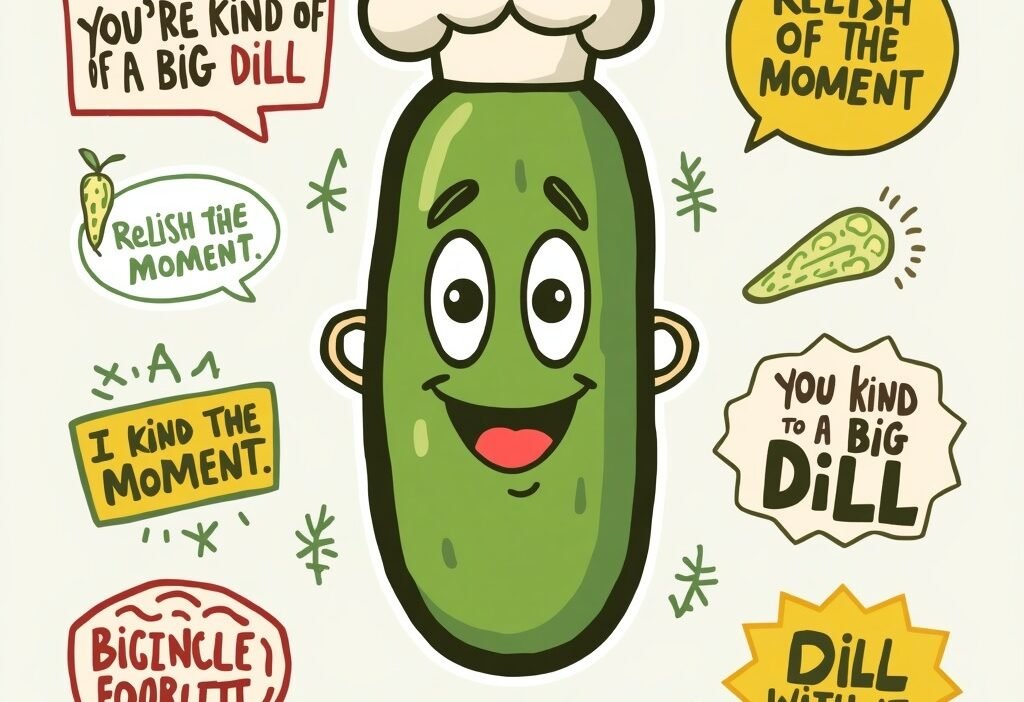
A quick note before we get brined: If you came here looking for a serious culinary essay on the fermentation process of cucumbers, you are in the wrong aisle. If you came looking for the best pickle puns on the internet to make your friends groan, your kids giggle, and your group chat question their life choices, congratulations—you have found your people. We have brine, we have bad decisions, and we have a cucumber who thinks he is a big deal. Let’s get sour.
Why Pickle Puns Are a Big Dill
Here is a fact I have not verified but deeply believe: the pickle is the funniest vegetable in the refrigerator. It sits there in its little jar, green and wrinkled, floating in mysterious liquid, wearing a label that says “refrigerate after opening” as if anyone has ever needed that instruction. It is a cucumber that has been through something. It has a backstory. It has texture. It has, dare I say, personality.
That is why pickle puns work. The vocabulary is absurdly rich. You have “dill,” “brine,” “jar,” “sour,” “kosher,” “gherkin,” “spear,” “chip,” “relish,” and “pickle” itself—a word that already sounds like a joke. It is impossible to say “gherkin” in a serious tone of voice. Try it. I will wait. You cannot.
The other reason pickle humor is so reliable is that it is inherently clean. There is no dark corner of pickle comedy. A pickle is a small green vegetable in a glass jar. The worst thing it can do is be sour, and sour is just a flavor. You can tell pickle jokes to a toddler, a grandparent, a classroom, or a very serious coworker, and the worst possible outcome is a polite nod and a whispered request that you never do that again.
And unlike jokes about politics or traffic or the state of the world, pickle puns ask nothing of you. You do not need context. You do not need to be up on current events. You just need to accept that a cucumber can be a character and that “dill” is the funniest word in the English language. If you can do that, you are ready. Let us begin.
The Classics: Pickle Puns That Have Been in the Jar for Years
Some jokes are timeless. Some jokes are so old they have started to ferment. The best pickle puns live in both worlds at once—they are the comfort food of comedy, predictable and warm and deeply satisfying if you are in the right mood. These are the ones you have definitely heard before, and you will absolutely send them to your group chat anyway, because they still work.
What do you call a pickle that is good at math?
A dill-igent student.
This is the foundational text of pickle humor. It is simple. It is pure. It requires zero explanation. “Dill-igent” is a single syllable away from “diligent,” which means hardworking, which is exactly what a pickle who studies math would be. If someone does not smile at “dill-igent,” check their pulse. They may actually be a cucumber.
Why did the pickle get promoted?
Because he was outstanding in his field.
This is the best pickle pun ever constructed, and I will not be taking questions. It works on every level. It is a pickle pun. It is a farm joke. It is a workplace compliment. You could put it on a mug and sell it to every office worker in the English-speaking world. The pickle was a cucumber, cucumbers grow in fields, and now he has a corner office. Beautiful.
What do you call a pickle that tells jokes?
A funny gherkin.
The word “gherkin” is doing a lot of heavy lifting here. It is a small pickle, and it is also a word that sounds like it belongs in a nursery rhyme. Combine it with “funny” and you have a character—a tiny pickle with a microphone, telling jokes to a crowd of smaller pickles. This is the energy we need more of.
Why did the pickle go to therapy?
Because he was in a real pickle.
This one is a classic setup-punchline structure. The phrase “in a pickle” already exists. You are not inventing anything. You are simply reminding the listener that the phrase exists and that it is, in fact, a vegetable joke waiting to happen. Therapy is a serious topic, but this joke is not. It is a pickle in a waiting room, holding a magazine, wondering how he got there.
What do you call a pickle that never gives up?
A per-severe-ant pickle.
I will admit this one is a stretch. It is more of a sound-alike than a true pun. But persistence is a virtue, and so is a pickle who refuses to quit. Imagine a small pickle in a tiny gym, wearing a headband, doing one more rep. That is the energy we should all bring to Monday mornings.
The Dill Files: The Funniest Word in the Pickle Kingdom
If pickles are the kings of the pun kingdom, then “dill” is the court jester. It is a herb, a flavor, and a word that exists primarily to be inserted into other words for comedic effect. It is the great equalizer. No matter how serious a sentence may be, you can add “dill” to it and watch it collapse into silliness.
What do you call a pickle that is a great detective?
Sherlock Dills.
This is a masterpiece. It works as a pickle pun. It works as a Sherlock Holmes reference. It works as a character you can picture immediately: a pickle in a deerstalker hat, holding a magnifying glass with a tiny pickle hand, saying “Elementary, my dear gherkin.” If you only remember one joke from this entire article, make it this one. Write it on a sticky note. Put it on your refrigerator, next to the jar.
What do you call a pickle that is always calm?
A dill-plomatic pickle.
The word “diplomatic” means tactful and calm, which is exactly what you want in a pickle. The idea of a pickle in a tiny suit, negotiating a peace treaty between the sour and the sweet factions of the refrigerator, is the kind of absurdist joy we need more of.
What do you call a pickle that is very good at what it does?
A dill-ightful professional.
I am stretching the format here, but the spirit is correct. Pickles who are good at their jobs deserve recognition. Pickles who are delightful deserve even more recognition. Pickles who are both? They get a promotion and a corner office in the produce aisle.
What is a pickle’s favorite kind of music?
Dill-ectro pop.
It is a pun. It is a genre. It is a lifestyle. If you are not currently imagining a pickle in a leather jacket holding a synthesizer it cannot actually reach, please try harder. The pickle is on stage. The crowd is going wild. The song is called “Brine On Me.” It is a hit.
What do you call a pickle who is a little bit rude?
A dill-inquent.
The visual here is devastating. Imagine a small pickle in a leather jacket, leaning against a brick wall, chewing gum, saying “You got a problem with fermented vegetables?” It is the perfect metaphor for a cucumber who has gone off the rails. It is also a great word. Dill-inquent. Say it out loud. It is fun.
The Jar Files: Pickles in Their Natural Habitat
The pickle jar is a strange and wonderful place. It is a glass cylinder full of green shapes floating in liquid, and it sits in the door of your refrigerator like a small aquarium. It is the source of many of the best pickle puns, because the jar is the pickle’s home, its office, and its social club all at once.
How do pickles like to communicate?
They use a jar-gon.
This is the pun that makes you feel smart and silly at the same time. “Jargon” means specialized language, and “jar” is the pickle’s home. Combine them and you have a pickle who speaks in a secret language that only other pickles understand. It is the kind of joke a librarian would appreciate. It is the kind of joke you can put on a coffee mug. It is the kind of joke you will think about at 2:00 AM for no reason.
What do you call a pickle that is in charge?
The jar-iff.
A sheriff, but a pickle. A pickle with a badge and a hat and a very serious expression. The jar is the town. The pickles are the citizens. The jar-iff keeps the peace. He is not to be trifled with. He is also, and I cannot stress this enough, a small green vegetable.
Why did the pickle get kicked out of the jar?
He could not keep his brine to himself.
This is the pickle equivalent of “he could not keep his mouth shut.” It is a social faux pas in the pickle community. The other pickles are deeply disappointed. The jar has a meeting. There is a vote. The pickle is asked to leave, politely, with a small suitcase and a lot of regrets.
What do you call a jar full of pickles who are all telling jokes?
A comedy club.
The image here is excellent. The pickles are on stage. There is a tiny microphone. There is a pickle in the back doing a “what’s the deal with cucumbers” routine. The audience is laughing. The brine is splashing. It is a good night for everyone.
What do you call a pickle that is a great dancer?
A jar-dancer.
A play on “gardener,” but also a pickle who can move. The idea of a pickle doing a little dance in its jar is inherently funny. It is even funnier if you imagine the brine sloshing around. It is the kind of joke that works best if you make a little sloshing sound after delivering the punchline. Presentation matters.
Pickle Puns for Kids (And Adults Who Refuse to Grow Up)
There is a special category of humor that exists purely to make children laugh. It is not sophisticated. It is not subtle. It is, however, deeply effective. The following pickle puns have been field-tested on actual children and found to produce a minimum of three giggles and one “that was terrible” from the nearest adult.
What do you call a pickle that tells good jokes?
A dill-ight.
Simple. Effective. Works best if you say it with genuine enthusiasm, as if you have just discovered a new flavor of ice cream. The pickle is a delight. The joke is a delight. Everything is a delight.
What do you call a pickle that is a little bit sick?
A dill pickle.
This one is a dad joke in its purest form. The pickle is already a dill pickle. The word “ill” is already inside it. The joke is that the pickle is sick, and the answer is that it is just a normal pickle. It is a joke that explains itself, which is both its strength and its weakness. Kids love it. Adults groan. That is the cycle of comedy.
Why did the pickle not want to be eaten?
Because he was a big dill.
The word “deal” is replaced with “dill,” which is both a flavor and a way of saying something is important. The pickle is important. The pickle has value. The pickle does not want to be a snack. This is a pickle with self-respect.
What do you call a pickle that does not take a bath?
A stink-gerkin.
I apologize in advance to any parents who will now hear this joke for the next three weeks straight. But it is a necessary part of the pickle pun ecosystem. The stink-gerkin is a foundational character. He is not proud of his choices. He is simply a pickle who has made a series of decisions that have led him here.
What do you call a polite pickle?
A please-ant pickle.
Manners matter. Even in the brine. Especially in the brine. Imagine a pickle saying “please” before being placed on a sandwich. The sandwich is grateful. The pickle feels heard. It is a small but meaningful exchange.
The Art of the Pickle Compliment: Puns That Actually Make People Feel Good
Here is a secret about puns: they do not have to be purely for laughs. A well-placed pun can also be a compliment. It can be a way of telling someone you appreciate them without having to be earnest and vulnerable, which is terrifying. Pickle puns offer a loophole.
You are dill-ightful.
This is the classic. It can be a text message. It can be a note in a lunchbox. It can be a caption on a photo of someone who is, in fact, delightful. It is impossible to be offended by being called “dill-ightful.” It is scientifically proven. The pickle said so.
You are one in a dill-ion.
This one is slightly more dramatic. It suggests rarity. It suggests that the person is special, like a perfectly preserved gherkin, but in a flattering way. Use it on an anniversary. Or a Tuesday. No judgment. The pickle approves.
You are my favorite dill.
This one is for best friends and significant others. It suggests that of all the dills in the world, this person is the best one. It is a small, specific, deeply sincere compliment wrapped in a joke. The pickle is proud of you.
You make my heart dill-ate.
This is the pun that works best when delivered with a completely straight face. The person you are speaking to will pause. They will process. They will either laugh or walk away. Either outcome is acceptable. The pickle is neutral on this one.
You are brine-tastic.
A play on “fantastic,” but with brine. The pickle is enthusiastic. The pickle is supportive. The pickle believes in you. This is the kind of compliment you can say to a coworker on a Monday morning and watch their face transition from confusion to delight to mild concern. That is the cycle of comedy.
Frequently Asked Questions (Because Google Likes Structure and So Do We)
What are some clean pickle puns for kids?
Clean pickle puns are jokes that rely on wordplay rather than anything rude or inappropriate. Good examples include “What do you call a pickle that is good at math? A dill-igent student,” “Why did the pickle get promoted? Because he was outstanding in his field,” and “What do you call a pickle that tells jokes? A funny gherkin.” These are safe for classrooms, family dinners, and birthday parties.
Why are pickle puns so popular?
Pickle puns are popular because pickles are universally recognizable, inherently a little bit absurd, and the vocabulary associated with them (dill, brine, gherkin, jar, spear) is rich with potential for wordplay. Additionally, pickle humor is generally clean and family-friendly, which makes it accessible to a wide audience. The word “pickle” itself sounds like a joke, which helps.
What is the best pickle pun of all time?
While “best” is subjective, the pun “Why did the pickle get promoted? Because he was outstanding in his field” is widely considered one of the cleverest. It works on multiple levels: it is a pickle pun, a farm joke, and a workplace compliment. The pun “What do you call a pickle that is a great detective? Sherlock Dills” is a close second.
Are pickle puns appropriate for school?
Yes, pickle puns are generally appropriate for school environments because they are clean and family-friendly. They rely on wordplay and silly situations rather than anything offensive. Teachers can use them as icebreakers, brain breaks, or writing prompts. A pickle in a tiny hat is not offensive to anyone.
What is a good pickle pun for a birthday card?
A good pickle pun for a birthday card is “You are kind of a big dill!” or “Hope your birthday is dill-ightful!” These are cheerful, positive, and appropriate for all ages. For a slightly more clever option, you could write, “You are one in a dill-ion, and I am so glad you were born.” That one is sincere and silly at the same time.
How many pickle puns are there?
There are effectively infinite pickle puns because language is flexible and people keep inventing new ones. However, most collections curate between 100 and 300 of the best and cleanest examples. The core structure of pickle humor relies on a relatively small set of sounds and words, which means the best puns tend to get recycled and refined over time. The jar is always open for new ideas.
How to Deploy Pickle Puns in the Wild (A Practical Guide)
You have read the jokes. You have chuckled. You have groaned. Now comes the hard part: actually using them. There is an art to pun delivery. It is not enough to simply say the words. You must commit. You must look the other person in the eye. You must not laugh at your own joke before you finish it. You must pause, just for a moment, after the punchline, to let the silence do its work.
The Dinner Table Deployment. Wait until there is a lull in conversation. Then, casually, as if you are commenting on the weather, say, “You know, I read today that pickles are very diligent students.” Then take a bite of your food. Do not elaborate. Let the confusion settle. Let the realization dawn. The groans will follow.
The Classroom Icebreaker. If you are a teacher, you have a captive audience. Use this power wisely. Write a pickle pun on the board at the beginning of class. Do not mention it. Let the students find it. Let them puzzle over it. At the end of class, if no one has said anything, ask, “Did anyone figure out the joke?” Then explain it. Watch their faces transition from confusion to delight to mild annoyance. That is the cycle of comedy.
The Group Chat Ambush. This is the most common modern deployment method. It requires no setup and no eye contact. Simply send a pickle pun into a group chat at 2:00 PM on a Wednesday. Do not provide context. Do not explain. If someone responds with “?” do not reply. If someone responds with a laughing emoji, you have succeeded. If someone responds with “I am leaving this chat,” you have also succeeded, but in a different way.
The Lunchbox Note. For parents of small children, this is the highest calling. Write “You are dill-ightful” on a sticky note. Attach it to a sandwich. Your child will either be deeply embarrassed or deeply delighted. There is no middle ground. Either way, you have made an impact. The pickle is proud of you.
The Refrigerator Door. This is the pickle’s natural habitat. Write a pickle pun on a piece of paper and tape it to the refrigerator door, right next to the jar. Every time someone opens the fridge, they will see it. They will groan. They will close the fridge. They will open it again five minutes later and groan again. This is the highest form of comedy.
A Brief (and Completely Unnecessary) History of the Pickle Pun
The word “pickle” comes from the Dutch word “pekel,” which means brine or a salt solution used for preserving food. The Dutch were very good at preserving things, and they were also very good at trading, which is how the pickle made its way around the world. By the time the pickle arrived in America, it was already a serious food item, served in delis and diners and on small plates next to sandwiches.
But language has a way of doing what it wants. Within decades of the pickle’s rise to cultural prominence, people were already making jokes about it. The Victorians loved a good pun (they also loved bad puns; they were not picky). By the time the modern deli culture emerged in the early twentieth century, the pickle was already a comedy character as much as a condiment. It was the little green vegetable that could. It was sour. It was salty. It was funny.
The modern pickle pun as we know it—the “dill-igent student,” the “Sherlock Dills,” the “jar-gon”—is largely a product of the late twentieth century. It emerged alongside the rise of family-friendly food humor and the internet’s endless appetite for wordplay. It has been passed down through generations of parents, teachers, and extremely enthusiastic uncles. Today, pickle puns are a global phenomenon. They exist in every language that has a word for pickle. They are printed on t-shirts and coffee mugs and jar labels. They are told in classrooms and around campfires and in the produce aisle of your local grocery store. They are, in their own small way, a form of human connection. A way of saying, “I have nothing profound to offer you, but I do have this joke about a pickle in a tiny hat.”
And honestly? That is enough.
The Final Crunch: A Closing Argument for Silly Humor
We live in a complicated world. There are bills to pay and emails to answer and news cycles to endure. The adult world is full of things that are serious and important and deeply unfunny.
Pickle puns are not serious. They are not important. They are not going to solve any of the world’s problems. But they are going to make a seven-year-old laugh at the dinner table. They are going to make a boring Tuesday slightly less boring. They are going to remind you, for just a moment, that not everything has to be productive or meaningful or optimized for maximum efficiency.
Sometimes, a pickle in a detective hat is enough.
So go forth. Tell a pickle pun. Annoy someone you love. Make a child giggle. Put a “dill-ightful” in your next presentation and see who notices. The world needs more groans. It needs more eye rolls. It needs more people who are willing to be a little bit silly.

George Smith is a humor enthusiast and writer at PunsStock, where he shares clever puns, funny jokes, witty one-liners, and lighthearted observations. With a passion for wordplay and everyday humor, George enjoys finding the funny side of ordinary moments and turning them into something worth sharing.
When he’s not writing, you’ll probably find him collecting terrible dad jokes, discovering clever wordplay, or trying to make someone laugh.
George Smith — Making words a little funnier, one pun at a time.